
Electric Pulling Winch
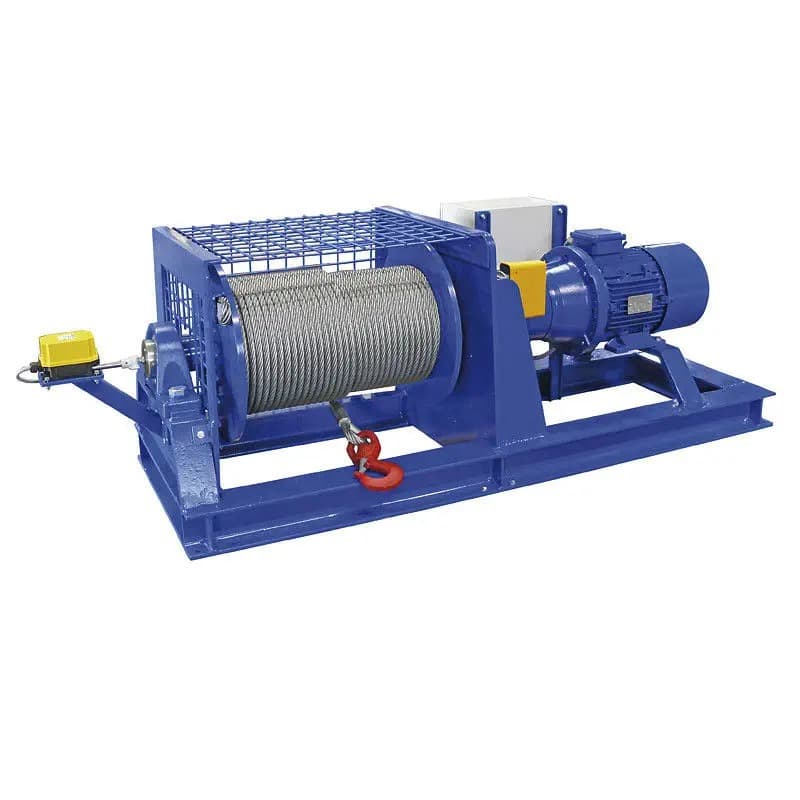
An electric pulling winch is a motorised winch for hauling, pulling and tensioning loads horizontally or up an incline. An electric motor drives a drum carrying a steel wire rope or synthetic rope, and a brake holds the load when the motor stops. The winch is intended for loads that are dragged or rolled, and must not be used to lift a load vertically, since it lacks the braking system and safety factors of a lifting winch. Types by application Fixed industrial pulling winches: winches with a steel frame anchored to the floor, used in plants, shipyards and rail depots for repeated hauling of carts and heavy loads along a fixed route. They run on three-phase power, have a large cable capacity drum and overload protection, and are designed for frequent duty cycles. Cable pulling winches: winches for electrical, infrastructure and telecom contractors pulling cables through ducts, conduits and tunnels. They run on single-phase or three-phase power, usually with several speeds, tension control and foot pedal operation that leaves the operator's hands free. Selection data Pulling force: the winch's pulling force is highest on the first layer of rope on the drum and decreases as layers build up. Calculate the required force for the layer the winch will work on. A load on wheels needs far less force than one dragged along the ground, and an incline increases the force required. Rope type: steel wire rope resists abrasion against concrete and rock, but is dangerous if it breaks. Synthetic rope is lighter and less dangerous on breaking, but sensitive to heat, friction and UV. Duty cycle: determine whether the winch will work occasionally or continuously for hours, and choose a model designed for it. Operating voltage: single-phase or three-phase, depending on what is available on site. The model table lists the pulling force, cable capacity, pulling speed and operating voltage for each model.
Series data
- Capacity
- 1250–37000 kg
- Drive
- Electric
- Duty class (hoisting)
- 1Am (drum)
- Series code
- PHW-E
Models in this series
| Model | Capacity | Lift height | Notes |
|---|---|---|---|
| PHW 300-E | 1.250 kg (875 kg) | 24 m / 155 m | recommended rope diameter 9 mm · rope speed 8.5/12.5 m/min · motor power 2.2 kW · order no. H50091 |
| PHW 301-E | 2.000 kg (1.400 kg) | 24 m / 155 m | recommended rope diameter 11 mm · rope speed 8.5/12.5 m/min · motor power 3 kW · order no. H50092 |
| PHW 304-E | 3.000 kg (2.100 kg) | 24 m / 155 m | recommended rope diameter 14 mm · rope speed 8.5/12.5 m/min · motor power 5.5 kW · order no. H50175 |
| PHW 305-E | 4.000 kg (2.800 kg) | 24 m / 155 m | recommended rope diameter 16 mm · rope speed 8/11.5 m/min · motor power 5.5 kW · order no. H50071 |
| PHW 306-E | 5.500 kg (3.800 kg) | 24 m / 155 m | recommended rope diameter 19 mm · rope speed 8/11.5 m/min · motor power 7.5 kW · order no. H50072 |
| PHW 307-E | 7.000 kg (4.900 kg) | 24 m / 155 m | recommended rope diameter 22 mm · rope speed 8/11.5 m/min · motor power 11 kW · order no. H50073 |
| PHW 309-E | 9.000 kg (6.300 kg) | 24 m / 155 m | recommended rope diameter 24 mm · rope speed 10/14 m/min · motor power 15 kW · order no. H50074 |
| PHW 310-E | 12.000 kg (8.400 kg) | 24 m / 155 m | recommended rope diameter 28 mm · rope speed 8/11.5 m/min · motor power 18.5 kW · order no. H50093 |
| PHW 311-E | 15.000 kg (10.400 kg) | 23 m / 154 m | recommended rope diameter 32 mm · rope speed 7.5/11 m/min · motor power 22 kW · order no. H50075 |
| PHW 313-E | 18.000 kg (12.400 kg) | 22 m / 153 m | recommended rope diameter 34 mm · rope speed 6/9 m/min · motor power 22 kW · order no. H50076 |
| PHW 314-E | 23.000 kg (16.000 kg) | 22 m / 153 m | recommended rope diameter 38 mm · rope speed 6/9 m/min · motor power 30 kW · order no. H50177 |
| PHW 315-E | 30.000 kg (20.400 kg) | 20 m / 145 m | recommended rope diameter 44 mm · rope speed 6/9 m/min · motor power 30 kW · order no. H50094 |
| PHW 316-E | 37.000 kg (24.500 kg) | 18 m / 137 m | recommended rope diameter 48 mm · rope speed 6/9 m/min · motor power 45 kW · order no. H50095 |
Figures are copied from the manufacturer's catalogue, in the order it lists them.
Other series in this category
Need a quote for this series?
Tell us what you need: capacity, lift height and environment, and we will come back with a specification and a price.
Request a quote