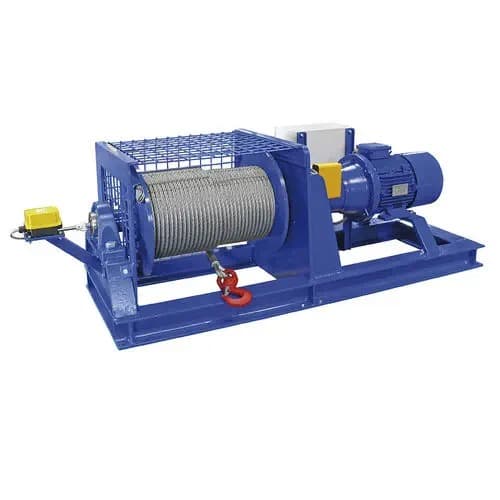
Wire Rope Winches

A pulling winch moves a load horizontally, dragging it across a surface or hauling it along a track, rather than lifting it vertically off the ground. That distinction drives the design, the classification and the safety requirements. We supply pulling winches in three drive types, from 1.2 to 37 tonnes. The electric version runs an IP54 braked motor rated 2.2 to 45 kW. The pneumatic version works at 7 bar with an air consumption of 90 to 350 litres per second, which suits areas where electricity is not permitted. The hydraulic version is the fastest of the three at up to 35 m/min, and fits mobile equipment that already carries a hydraulic system. The drum is built to classification 1Am with a diameter at least 16 times the rope diameter, and the rope is selected for the pulling force at the fifth rope layer rather than the first. This is easy to miss: the force drops by roughly thirty percent between the first layer and the fifth, so we publish both figures for every model. The standard build ships without rope and without controls, both selected separately to suit the application. A load limiter is required under CE for any application above 1,000 kg working load limit. Explosion-proof motors and marine-duty versions are available, with paint systems to ISO 12944 grade C4 or C5-M.

Series and models

Each series states its figures exactly as the manufacturer's catalogue states them, and cites the catalogue and the page they came from.

Other categories

EOT Cranes

Bridge cranes for every branch of industry and warehousing: metals and steel, foundries and hot metal handling, concrete and precast elements, energy plants and power stations, wind energy and turbine assembly, chemical and petrochemical processing, water and wastewater treatment, ports and shipyards, plastics and rubber, paper and board, food and beverage, automotive and workshops, logistics centres and storage warehouses, machine rooms and pump houses. The crane moves along three axes, down the length of the building, across the bridge and vertically, and covers the entire floor area without forklifts and without temporary rigging. The first decision is the mounting method. A top running crane travels on rails carried by columns and uses almost the full height of the building, which suits heavy loads and wide spans. An underslung crane hangs from the roof structure, and suits cases where columns cannot be added or where the production floor has to stay clear, at the cost of a shorter span. The second decision is the number of girders. A single girder is lighter, less expensive and puts less load into the structure. A double girder carries far heavier loads and also gives more hook height in the same building, because the hook rises between the girders rather than below them. The third decision is the operating environment. A bridge crane is built around its hoist unit and electrical system, so it can be specified for the environment it will work in. Alongside the standard industrial build we supply versions for ATEX classified areas, for marine and coastal installations, for dusty and high humidity conditions and for aggressive chemical environments. The specification is fixed at the design stage rather than retrofitted, so the environment should be defined in your first enquiry. We supply 129 configurations across three series: single girder from 2 to 12.5 tonnes over spans of 10.5 to 31.5 metres, double girder from 5 to 50 tonnes over spans of 13.5 to 31.5 metres, and underslung from 2 to 10 tonnes over spans of 6 to 20 metres. Standard lifting height is 9 metres and the duty rating is A5 to FEM 2M. Every crane is engineered to your building dimensions, your loads and your operating environment rather than selected from a catalogue. We carry out the site survey, the design, the installation and the commissioning, and stay with the crane through routine maintenance for its working life.

See details

Need a quote for this?

Tell us what you need and we will come back with a specification and a price.

Request a quote
Call us nowChat with us on WhatsApp